Published September 11, 2026
Get Paid Faster: Exact Due Dates & Copy Ready Invoice Wording for SMBs

Invoice payment terms tell a buyer when and how to pay for goods or services rendered. The single most effective way to avoid confusion and late payments is to display an exact, bolded “Payment due by” date and your accepted payment methods on every invoice, rather than relying on a client’s accounts payable system to calculate it. This one habit reduces both days sales outstanding (DSO) and payment disputes, which is the foundation on which everything else in this guide builds.
TL;DR:
Extending payment terms from Net 30 to Net 60 doubles the average unpaid balance, increasing risk for the seller and benefiting larger buyers with better cash reserves.
Offering early-payment discounts like 2/10 Net 30 yields a high effective annualized rate of about 37%, but only benefits businesses with fast internal approval processes.
Using precise, bolded due dates with clear accepted payment methods on every invoice reduces disputes and errors, especially when integrated into automated invoicing systems.
Industry-specific standards influence common terms: construction favors milestone billing, retail uses due-upon-receipt, and wholesale relies on Net 30 to Net 90, impacting cash flow accordingly.
Keeping consistent invoice wording across all transactions and clauses helps maintain clear agreements and avoids negotiations that could erode firm payment policies.
Table of Contents
-
How Payment Terms Affect Your Cash Flow (DSO and DPO Explained)
-
Early-Payment Discounts and Late Fees: The Math That Actually Matters
-
How Automated Invoicing Reduces Disputes and Speeds Up Payment
What Do Invoice Payment Terms Mean for Your Business?
Payment terms are the conditions a seller sets for when and how an invoice must be paid, and they show up in a handful of standard formats you’ll see across almost every industry. Getting fluent in this vocabulary matters because a misread term is one of the most common, and most avoidable, causes of a late payment.
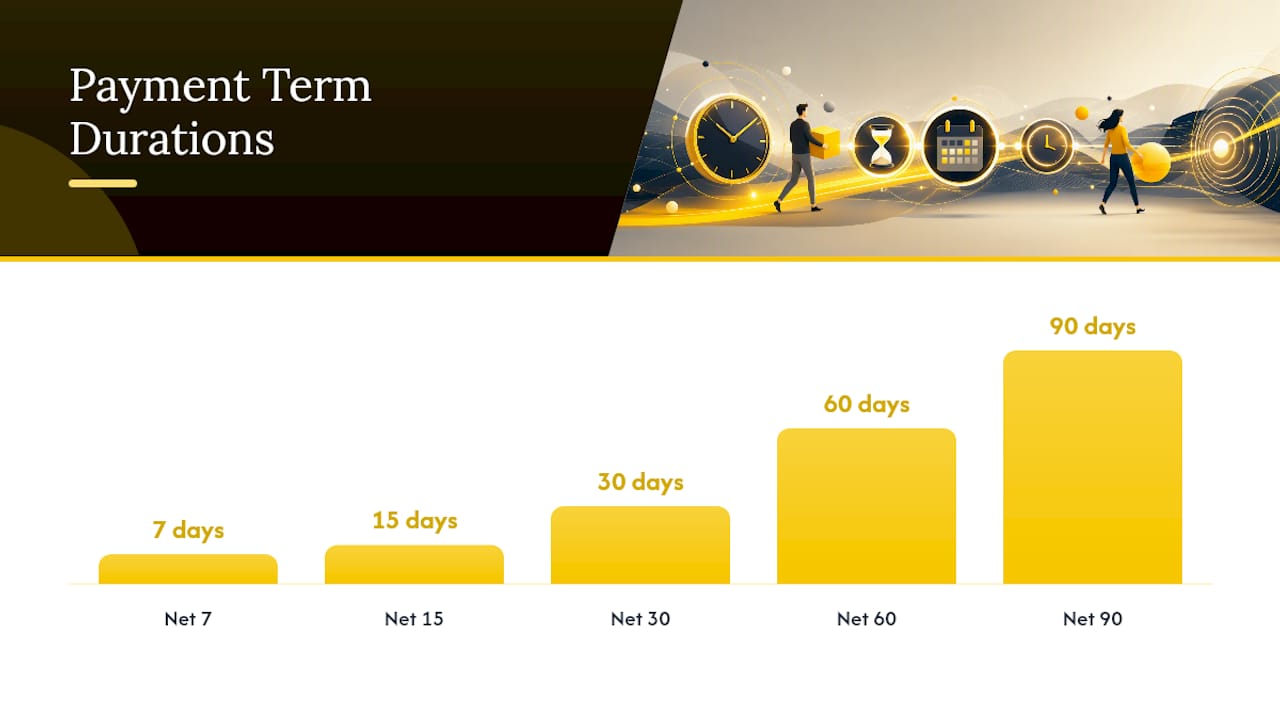
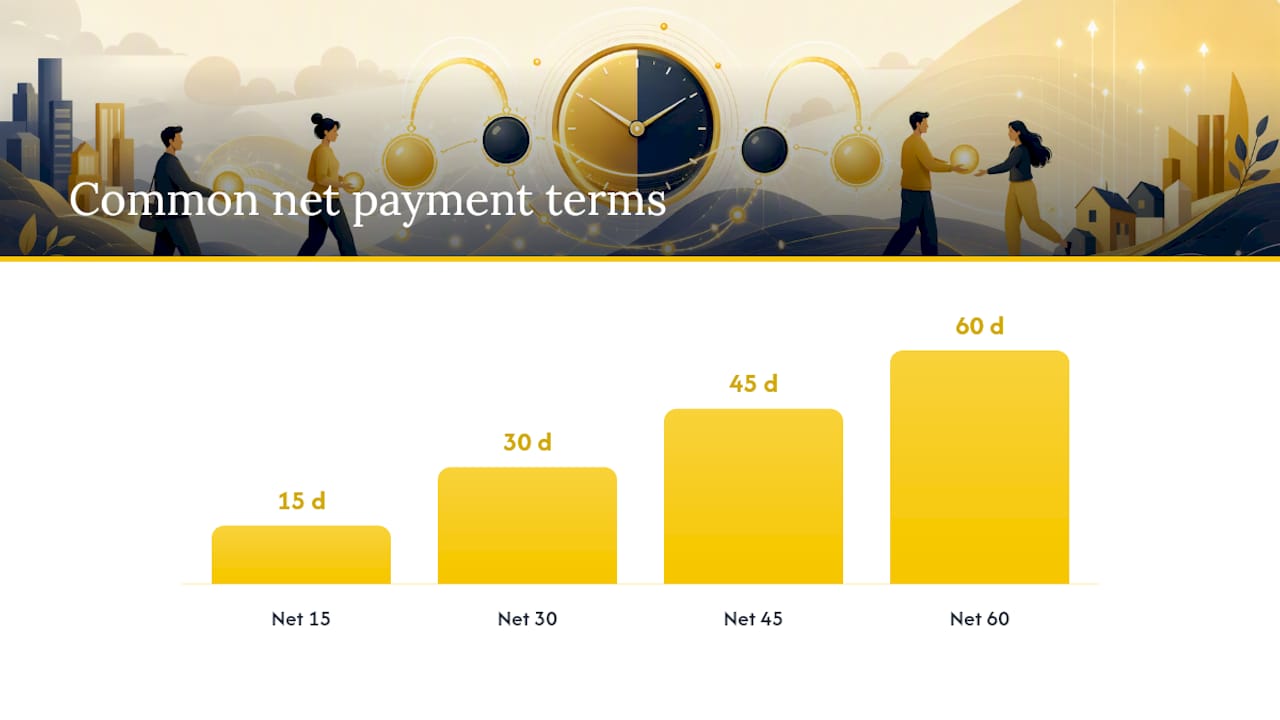
Net terms are the most familiar format. Net 30 means payment is due 30 days from the invoice date; Net 60 and Net 90 stretch that window further. Net 30 functions as the default standard for US business-to-business transactions, which is why it’s the term most buyers expect unless you specify otherwise. Net 7 and Net 15 are common for smaller jobs or trades where cash cycles run tighter, like residential service calls.
Discount shorthand combines a term with an incentive. The classic example is 2/10 Net 30: the buyer gets a 2% discount if they pay within 10 days, otherwise the full amount is due in 30. It looks like a small courtesy. As you’ll see in the next section, it’s actually one of the more expensive financing arrangements a business can offer without realizing it.
Immediate and advance terms shift risk toward the seller getting paid first:
-
Due upon receipt means payment is expected the moment the client gets the invoice, typically within a few business days in practice.
-
Cash in advance (CIA) requires full payment before work begins or goods ship, common for custom orders or new clients with no payment history.
-
COD (cash on delivery) ties payment to the moment goods or services are delivered.
-
CWO (cash with order) requires payment when the order is placed, often used for materials-heavy trades.
-
CBS (cash before shipment) is similar to CIA but specifically tied to a shipping event.
Calendar variants add a date-based wrinkle. EOM (end of month) terms mean payment is due at the close of the current month, regardless of which day the invoice was issued. MFI (most favored issuer), sometimes seen as a related calendar convention, ties due dates to a fixed point after the month’s end rather than the invoice date itself. This is where a lot of billing confusion creeps in: a Net 30 invoice dated March 3 is due April 2, but if the buyer’s AP team starts the clock from when they received it, say March 6, the internal due date drifts to April 5. QuickBooks recommends spelling out whether terms run on business days or calendar days precisely because this ambiguity is so common, and a due-date calculator can settle the math when a due date lands on a weekend or holiday.
Industry context shapes which terms show up where. Construction and trade services often use milestone or progress billing tied to project phases rather than a flat net term. Retail and e-commerce lean on due-upon-receipt or CIA for one-off transactions. Wholesale and manufacturing rely heavily on Net 30 to Net 90 because buyers are reselling inventory and need the float. Professional services split the difference, often mixing a deposit with Net 15 or Net 30 for the balance.
How Payment Terms Affect Your Cash Flow (DSO and DPO Explained)
Every payment term you set has a direct, measurable effect on two numbers: your days sales outstanding (DSO), which tracks how long it takes you to collect payment after a sale, and your customer’s days payable outstanding (DPO), which tracks how long they hold onto their cash before paying you. These two metrics are mirror images of the same transaction, and whoever sets the term controls who benefits.
The Trade-Off in Numbers: Moving a client from Net 30 to Net 60 doesn’t just delay a single payment. It effectively doubles the average outstanding balance you’re carrying on that account at any given time, since you now have two full billing cycles of unpaid invoices in play instead of one. Extending terms raises seller DSO while lowering buyer DPO, which is exactly why larger buyers push for longer terms and smaller vendors often can’t afford to grant them.
The math on early-payment discounts tells a similar story from the other direction. A 2/10 Net 30 discount looks like a 2% cost of doing business, but annualized, it’s closer to a 37% return on capital for whoever takes it. That’s because you’re giving up 2% in exchange for getting paid 20 days sooner, and when you stretch that 2% saving across a 365-day year, the effective rate climbs fast.
Who benefits from which side of this arrangement depends on position, not preference:
-
Buyers with strong cash reserves benefit from extended terms because they get free financing on inventory or services they haven’t yet paid for.
-
Sellers carrying tight margins take on real risk when they extend terms, since every day of DSO growth is a day of revenue sitting on someone else’s balance sheet instead of theirs.
-
Small vendors selling to large buyers often have the least leverage to negotiate shorter terms, even though they’re usually the ones who can least afford the float.
If your business is granting Net 60 or Net 90 terms because a major client demands them, that’s a legitimate strategic trade for the relationship. Just track the DSO impact honestly rather than treating it as a paperwork detail.
How to Choose the Right Payment Terms for Your Clients
Setting a payment term isn’t a one-size answer. It’s a decision that should weigh four factors every time: your own cash position, the client’s payment history, what’s standard in your industry, and how much negotiating leverage you actually have.
-
Check your cash runway first. If a delayed payment from one client would strain payroll or materials purchases, you can’t afford to offer generous terms no matter how attractive the client looks on paper.
-
Pull the client’s payment history. A returning client with a clean track record earns more flexibility than a first-time buyer with no history at all.
-
Match, don’t guess, industry norms. Offering Net 15 in an industry where Net 30 is standard can make your business look inflexible without any real cash-flow benefit.
-
Weigh your leverage honestly. A vendor with a unique specialty or limited competition can hold firmer terms than one competing on price alone.
-
Confirm the purchase order before you invoice. Negotiation over payment terms usually happens at the PO stage, and a mismatch between the PO terms and the invoice terms is one of the most common reasons payments get frozen in an approval queue.
For new clients, unproven projects, or large custom jobs, require a deposit or set up milestone billing instead of a single net term. A 50% deposit with the balance due on completion protects your cash position without demanding full payment upfront, which most clients will resist.
Watch for a few red flags that justify stricter terms outright: a new client who hesitates to share basic business information, a history of disputed invoices with other vendors (if you can find it), or a request for unusually long terms paired with a large order size. Any one of those is a reasonable basis for requiring a deposit or shortening your standard net window.
Pro Tip: Offer staged concessions instead of caving to the first counteroffer. If a client pushes for Net 60, counter with Net 45 plus a 1% early-payment discount. You preserve some cash-flow protection while still giving them a reason to feel like the negotiation moved in their favor.
How to State Payment Terms Clearly on Your Invoice
The layout of your invoice does as much work as the terms themselves. Stating the exact due date in bold, in its own visible block, meaningfully reduces mis-entry when a client’s accounts payable system logs the invoice, because most AP software defaults to the date it received the document, not the date you actually intended.
A complete, unambiguous invoice includes these fields:
-
Payment due by [specific date], not just “Net 30,” so there’s no calculation left for the client to get wrong
-
Invoice date and invoice number
-
Purchase order (PO) reference number, matched exactly to what the client has on file
-
Accepted payment methods (check, ACH, card, online payment link)
-
Remittance details, including where and how to send payment
-
Discount deadline, if you’re offering one, stated as an exact date rather than “within 10 days”
-
Late fee terms, including the percentage and when it kicks in
Here’s sample wording you can adapt directly:
-
Due upon receipt: “Payment is due immediately upon receipt of this invoice.”
-
Net 30: “Payment due by April 15, 2026 (Net 30 from invoice date).”
-
2/10 Net 30: “2% discount if paid by March 26, 2026. Full amount due by April 15, 2026.”
-
Deposit or milestone billing: “50% deposit due upon signing; remaining balance due upon project completion.”
PayPal’s summary of standard invoice fields echoes this same structure, and it holds across almost every industry: the more explicit the date and method, the fewer questions land in your inbox. A well-built set of invoice email templates can lock this wording in so you’re not rewriting it by hand every time.
Pro Tip: Keep your wording identical across every invoice and every contract you sign with a given client. If your contract says Net 30 but your invoice says Net 45, the client will pay on whichever term benefits them, and you’ll have no clean basis to dispute it.
Early-Payment Discounts and Late Fees: The Math That Actually Matters
Early-payment discounts and late fees are two sides of the same lever: one rewards speed, the other penalizes delay. Both only work if the math behind them is sound.
Annualized Cost Check: A 2/10 Net 30 discount costs you roughly 2% of the invoice value to get paid 20 days sooner than your standard 30-day term. Stretch that 2% across a full year and the effective annualized rate lands close to 37%, which is a startlingly expensive form of financing when you compare it to almost any credit line or short-term loan. Before offering the discount broadly, run the comparison against your actual cost of capital.
There’s a catch that most guides skip: even if you want to offer the discount, you can’t capture it as a buyer unless your own accounts payable cycle moves faster than the discount window. If your internal approval process takes 15 days to cut a check, a 10-day discount window is worthless to you no matter how good the rate looks on paper.
Late fees deserve the same rigor. Anything harsher risks damaging the relationship without meaningfully improving your collection rate.
When a payment does go late, a consistent escalation flow protects both your cash and the relationship:
-
Day 1 to 3 past due: automated reminder email, no personal outreach needed yet
-
Day 7 to 10 past due: direct phone call or personal email from someone on your team
-
Day 15+ past due: formal payment plan offer if the client is otherwise reliable
-
Day 30+ past due with no response: collections referral or, for larger balances, consider invoice factoring to recover cash while the dispute plays out
Discounts and penalties both undermine your cash position when applied inconsistently. A discount you extend to some clients but not others invites resentment; a late fee you waive every time you’re asked trains clients to expect the waiver.
Copy-Ready Invoice Wording for Every Payment Term
You don’t need to draft new language every time you issue an invoice. These templates cover the scenarios most SMBs run into repeatedly.
-
Due upon receipt: “Payment is due immediately upon receipt. We accept card, ACH, and check.”
-
Standard Net 30: “Payment due by [date] (30 days from invoice date). Please reference invoice #[number] with payment.”
-
2/10 Net 30 discount: “Pay by [date, 10 days out] for a 2% discount. Full balance otherwise due by [date, 30 days out].”
-
Deposit and balance: “50% deposit ($X) due upon signing. Remaining balance ($X) due upon job completion.”
-
Milestone billing: “Payment due in three installments: 30% upon start, 40% at midpoint inspection, 30% upon final walkthrough.”
-
Subscription or retainer: “Recurring payment of $X due on the 1st of each month via saved payment method.”
For the email that carries the invoice, subject lines that name the amount and date outperform vague ones. Compare “Invoice attached” against “Invoice #4021: $2,400 due March 15” and it’s obvious which one a busy accounts payable clerk opens first. A short note in the body, something like “Let us know if you have any questions before the due date,” gives the client an easy path to flag a problem before it becomes a late payment instead of after.
How Automated Invoicing Reduces Disputes and Speeds Up Payment
Manual invoicing is where most of the errors covered so far actually happen: a typo in the due date, a missed reminder, a client who genuinely forgot because nothing followed up. Automation closes most of that gap without adding staff hours.
Standardized templates with a locked due-date field eliminate the single biggest source of AP mis-entry: a human retyping a date that should never have been ambiguous in the first place. When every invoice you send pulls from the same invoice management format, the “Payment due by” line is calculated automatically from your terms rather than typed fresh each time, which removes the error at its source rather than catching it after the fact.
Scheduled reminders matter just as much as the invoice itself. Combining consistent templates with embedded payment links and automated follow-up sequences reduces the manual chase time that eats into a bookkeeper’s week, because the system sends the nudge on day 3, day 10, and day 20 without anyone remembering to do it. Embedded online payment links inside the invoice itself remove another point of friction: a client who can pay with one tap from their phone has fewer excuses to let an invoice sit.
Once automation is in place, track a small set of KPIs to confirm it’s actually working:
-
DSO trend month over month, watching for a steady decline rather than a one-time dip
-
Percentage of invoices paid within the discount window, if you offer one
-
Overdue rate as a share of total invoices outstanding at any given time
-
Average days from send to payment, which tells you how much of your cycle is automation versus manual chasing
Balancing Firm Payment Terms With Good Client Relationships
Firm terms and good client relationships aren’t actually in tension, but a lot of business owners treat them that way. The mistake is assuming that being flexible with one client means you have to be flexible with everyone, or that saying no to a term request will cost you the account.
Be firm on the policy itself: a standard due date, a consistent late-fee structure, a clear deposit requirement for new or high-risk work. Be flexible on the exceptions, and only when they’re worth documenting. If a longtime client needs Net 45 instead of your standard Net 30 for one large order, put it in writing on the PO and the invoice, note why, and move on. What erodes a payment policy isn’t the exception itself, it’s the undocumented exception that quietly becomes the new expectation for every invoice after it.
The businesses that manage this well tend to separate the emotional decision (do I trust this client) from the operational one (what does my cash position actually allow right now). Those are two different questions, and answering them together is how firm terms turn into a pattern of one-off favors nobody agreed to formally.
— ServlyPro
Get Paid Faster With ServlyPro’s Invoicing Tools
Every practice covered in this guide, clear due dates, consistent wording, staged reminders, deposit handling, works better when it’s built into your workflow instead of something you have to remember on every invoice. ServlyPro handles that by design: invoice templates that lock in your due date and terms automatically, embedded online payment links so clients can pay from their phone in one tap, and follow-up automation that sends reminders on schedule without anyone on your team chasing a spreadsheet.
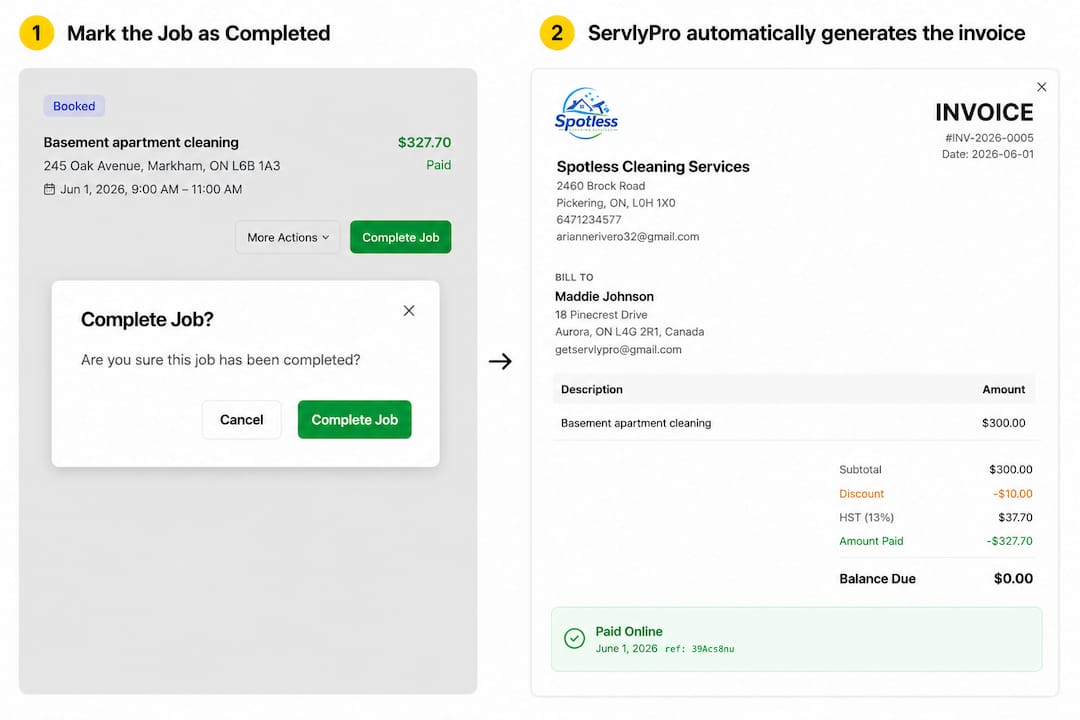
For service businesses juggling quotes, deposits, and milestone billing, ServlyPro also handles quote approvals and deposit collection in the same place your invoices live, so the payment terms you negotiate on the front end carry straight through to what the client sees on the invoice. If your current process still relies on manual reminders and a due date typed fresh each time, start a free trial and see what a locked, automated due-date field does to your overdue rate within the first billing cycle.
Sources
The figures and definitions in this guide draw from a small set of primary references worth bookmarking if you want to dig deeper:
FAQ
What are the standard payment terms for invoices?
Net 30 is the most common standard in US business-to-business transactions, though Net 15, Net 60, and due upon receipt are also widely used depending on industry and client relationship.
What do you write on an invoice for payment terms?
Write the exact due date in bold (for example, “Payment due by April 15, 2026”), the accepted payment methods, and any discount or late-fee terms, rather than relying on a shorthand like “Net 30” alone.
What does it mean when an invoice has a 30-day payment term?
It means the buyer has 30 days from the invoice date, or in some cases the receipt date if specified, to pay the full amount before the balance is considered overdue.
What are the best terms and conditions for invoice payment?
The best terms match your cash-flow needs and the client’s payment history, but nearly every strong policy shares three traits: a clearly stated due date, defined accepted payment methods, and a documented late-fee structure that’s applied consistently.
How do I decide between Net 30 and a shorter payment term?
Base the decision on your own cash position and the client’s track record. New clients or cash-tight periods justify shorter terms like Net 15 or due upon receipt, while established clients with clean payment histories can usually be trusted with standard Net 30.