Published September 9, 2026
Operations First After Hours Pricing for Small Field Service Shops
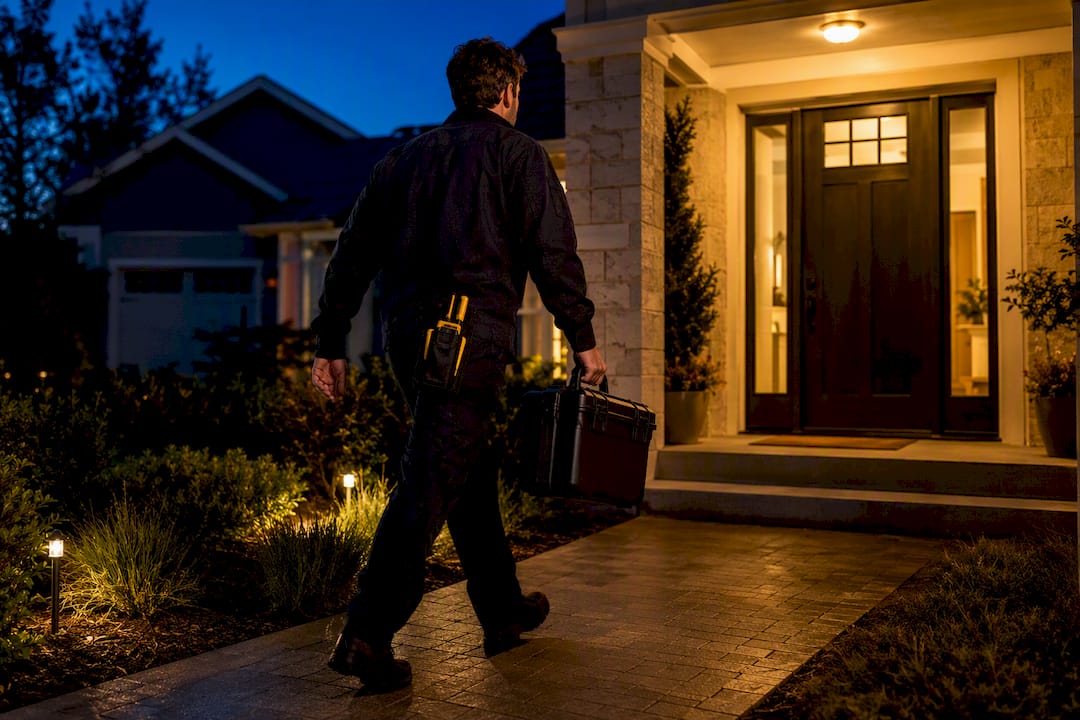
Charge a published after-hours dispatch fee plus a modest hourly multiplier, or a flat emergency minimum, and disclose the total in writing before your technician leaves the shop. That structure covers your real incremental costs and filters out callers who aren’t actually in a crisis. Test the number in the field for 60 to 90 days, then adjust the tier that’s losing money or losing bookings.
TL;DR:
Applying a flat dispatch fee plus a percentage multiplier, rather than a flat surcharge, best aligns with your costs and customer perception for after-hours calls.
Common rates include an 1.5x to 2x increase for weeknight after-hours and 2x to 3x for weekends, with dispatch fees ranging from $200 to $500 depending on the trade.
Calculating the premium based on actual incremental costs, including overtime, travel, and disruption, ensures a defensible and profitable after-hours rate.
Clear, written disclosure of rates and an approval step before dispatch significantly reduces customer disputes and chargebacks.
Automated quoting tools and structured approval workflows streamline compliance, reduce errors, and improve customer trust in your after-hours pricing process.
Table of Contents
Which After Hours Pricing Model Fits Your Trade?
Three structures cover almost every field-service business, and each solves a different problem.
A trip or dispatch fee is a flat charge for showing up outside normal hours, separate from labor. It’s the cleanest lever because it anchors the customer’s expectation the moment they hear it on the phone, and it compensates for travel and schedule disruption without complicating your labor math.
A flat surcharge adds a fixed dollar amount to the whole invoice regardless of job size. It’s simple to quote but can undercharge you on long emergency jobs and overcharge on quick ones.
A multiplier applies a percentage bump to your hourly labor rate. It scales with job length, which protects you on marathon repairs, but it’s harder to explain over the phone and easier for customers to dispute.
-
Plumbing and HVAC: multiplier plus dispatch fee, since job length varies widely
-
Electricians: flat surcharge works well for standardized panel and outlet calls
-
Locksmiths: dispatch fee alone often covers it, since most jobs run under an hour
Zone-based pricing (extra for calls outside your normal service radius) and response tiers (a premium for “within 60 minutes” versus “within 4 hours”) are optional layers on top of any base model, not replacements for one.
Pro Tip: Many shops get better results stacking a stiffer trip fee with a smaller hourly multiplier, rather than the reverse. Trip fees are the strongest lever for after-hours pricing because they hit the invoice before labor even starts, which shapes how the whole bill feels to the customer.
What Are Typical After Hours Rates and Minimums?
Your numbers need an anchor before you can defend them to a customer, an employee, or yourself at tax time.
The standard rate ladder most trades use runs:
-
Weeknight after-hours: 1.5x your daytime rate
-
Late-night (roughly 10 p.m. to 6 a.m.): 2x
-
Weekends and holidays: 2x to 3x
Dispatch fees follow a similar jump. Daytime service-call fees typically run $89 for HVAC, $75 to $100 for plumbing, and $125 to $175 for electrical work, while after-hours dispatch fees commonly land between $200 and $500, depending on trade and market.
For HVAC specifically, expect to stack a $150 to $500 after-hours dispatch fee on top of hourly labor billed at 1.5 to 3 times the daytime rate.
Minimum-hour billing protects you from very short emergency calls that barely cover expenses. A one-hour minimum at your after-hours rate, or a flat emergency minimum within a typical industry range regardless of time spent, keeps short jobs from bleeding your margin. Emergency premiums layered on top of the base call often range from $179 to $399 and get waived once the customer approves the full repair, which softens the sticker shock without costing you the visit fee.
How Do You Calculate an After Hours Premium?
Guessing at a multiplier is how shops end up either scaring off good customers or losing money on every night call. Build the number from your actual costs instead.
Start by listing every incremental cost that only shows up when you dispatch after hours:
-
Overtime labor burden — the wage differential plus payroll tax and workers’ comp adjustment for overtime hours
-
Dispatcher or answering-service cost — the per-call cost of staffing someone to take that 11 p.m. phone call
-
Isolated truck and travel cost — a technician driving alone at night often means extra fuel, mileage, and sometimes a safety stipend
-
Callback and disruption risk — night work has a higher error rate, and pulling a tech off their normal morning route creates a ripple cost across tomorrow’s schedule
Add those up per job, then apply this formula: required emergency premium = incremental cost ÷ (1 − target margin). This is the core calculation any shop can run before setting an after-hours rate.
Here’s a worked example for a plumbing call:
Round that $115 up to a clean $125 or $150 quoted price, since odd numbers read as arbitrary to customers. Before you finalize any multiplier, reconcile it against your state’s overtime rules and your actual payroll cost per hour. A pricing structure built on real margin math holds up under scrutiny in a way a number pulled from a competitor’s website never will.
How Should You Communicate After Hours Fees to Customers?
Almost every after-hours pricing dispute traces back to one failure: the customer didn’t hear the number before the truck showed up. Fix that, and most complaints disappear.
Your policy needs four things written down and repeated everywhere:
-
Time-band cutoffs stated in plain language (“after-hours rates apply from 6 p.m. to 8 a.m.”)
-
The exact fee structure, including whether the dispatch fee credits toward the final invoice if the customer approves the repair
-
Minimum charges for short or diagnostic-only calls
-
A clear approval step before any work or even travel begins
Script your CSR to say the dispatch fee and the multiplier out loud on the phone, every time, before confirming the appointment. Customers who hear those numbers before the visit rarely dispute them afterward. Follow the call with a text or email that repeats the fee, the estimated multiplier, and a line the customer taps to confirm.
Pro Tip: Publish your after-hours rates on your website, on the truck, and in the booking confirmation. Putting the fee in writing at every touchpoint before dispatch is the single change most likely to cut your chargeback rate. A structured quote-approval workflow makes that written “yes” easy to capture and easy to prove later.
Should Your Business Offer True 24/7 Coverage?
Not every shop should promise round-the-clock service, and pricing alone won’t fix a staffing problem.
The real constraint is on-call capacity. Below a small threshold of available technicians, true 24/7 coverage becomes unsustainable and pushes underpriced promises onto an overworked team rather than solving the customer’s problem. If you don’t have enough staff to rotate on-call duty without burning people out, limited after-hours windows or a partner referral arrangement, like the emergency coverage model some 24/7 plumbing, HVAC, and electrical providers run, beats overselling availability you can’t actually deliver.
Consider these factors before committing to 24/7:
-
Dispatcher and on-call stipend costs, which get folded into your incremental-cost calculation
-
Whether your technician pool can rotate without working six or seven consecutive days
-
Whether a membership or maintenance plan can offset the cost of standing coverage
Maintenance-plan members often get after-hours calls at standard daytime rates, and that benefit alone converts a meaningful share of emergency callers into long-term members, which subsidizes the cost of keeping someone on call.
How Do You Test and Monitor Your Pricing?
Set your rates, then watch what actually happens for two full billing cycles before you trust the numbers.
-
Log every after-hours call with time band, quoted fee, final invoice, and whether the customer approved or declined
-
Track margin per call against your incremental-cost formula, not just revenue booked
-
Watch callback rate by time band, since a spike after 1 a.m. calls often signals rushed diagnostics
-
Note technician next-day disruption, like missed morning appointments caused by a late-night job running long
-
Count complaints and chargebacks and tie each one back to whether the fee was disclosed in writing first
Reviewing results by time band and response promise tells you which tier to leave alone and which one needs a price adjustment. If a tier consistently misses margin after 60 to 90 days of clean logging, raise that specific band’s fee rather than adjusting your whole rate card.
What Legal Rules Apply to After Hours Rates?
Your after-hours multiplier has to survive contact with actual payroll law, not just customer expectations.
Overtime rules under the Fair Labor Standards Act govern what you owe hourly employees for after-hours dispatch, and those rules don’t automatically match the multiplier you charge customers. What it needs to cover is the real overtime differential plus payroll tax burden, which is usually smaller than the customer premium.
State rules add another layer. Some states mandate daily overtime after eight hours in addition to the federal weekly overtime threshold, which changes your incremental-cost math for technicians who start a normal shift and get pulled into a night call on the same day. Local licensing boards in some trades, particularly electrical and plumbing, also regulate how emergency work orders must be documented, including written scope-of-work and pricing disclosure before work begins.
None of this means you need a lawyer for every price change. It means your written approval step, discussed above, isn’t just a dispute-prevention tool. It’s also documentation that protects you if a customer later claims they weren’t told the rate. Keep a copy of every disclosed-fee confirmation for as long as your state’s contract-dispute statute of limitations runs, and check that figure with a local attorney or your state labor department rather than assuming a number.
How Do Customers Perceive Your After Hours Fees?
Customers don’t compare your after-hours rate to your daytime rate. They compare it to what they assume “emergency service” should cost, based on whatever they’ve seen from other trades or heard from a neighbor.
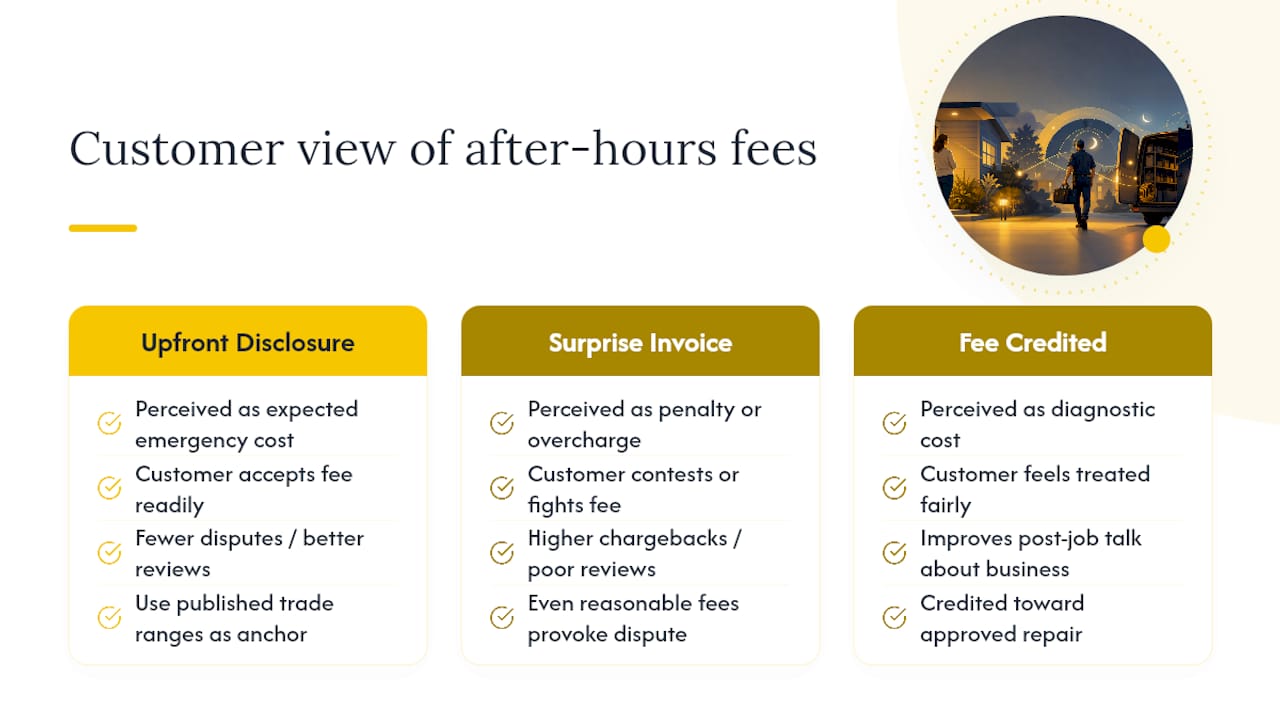
That assumption is usually inflated by horror stories, which works in your favor if you disclose your fee clearly and it lands anywhere near the ranges other shops in your trade publish. A customer who hears “$250 dispatch plus time and a half” before you arrive tends to accept it. A customer who sees that number for the first time on the final invoice tends to fight it, even when the number itself is reasonable.
Benchmarking against your local competitors matters less than benchmarking against your own disclosure habits. Two shops can charge the same $300 emergency minimum, and one gets five-star reviews while the other gets chargebacks, purely because one told the customer up front and the other didn’t. If you want a rough external anchor, the published ranges for HVAC emergency dispatch and labor multipliers give you a defensible number to point to if a customer asks why your rate isn’t the daytime rate.
The other perception lever is the credit. Waiving or crediting the dispatch fee toward an approved repair, a common practice noted in service-call fee benchmarks, makes the fee feel like a diagnostic cost rather than a penalty, which changes how customers talk about your business afterward.
How Should You Handle After Hours Fee Disputes?
Most disputes are avoidable, but the ones that happen anyway need a consistent process, not case-by-case improvisation.
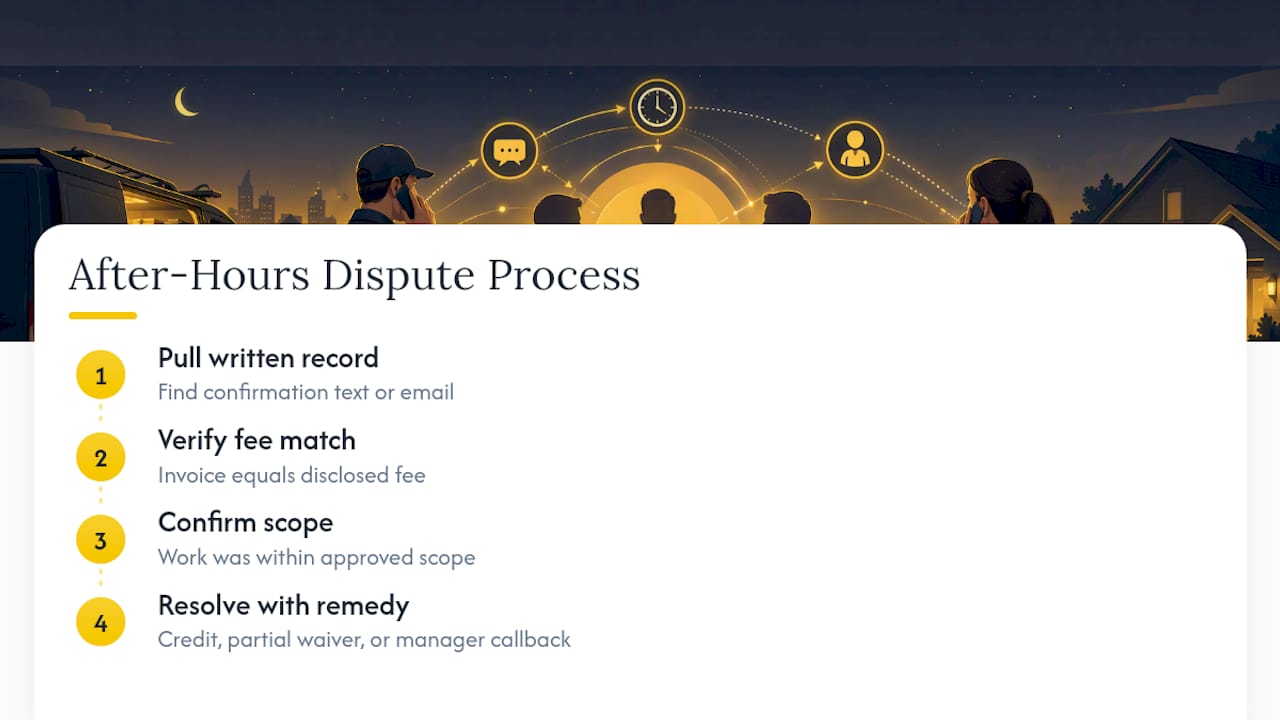
Start every dispute conversation by pulling the written record: the confirmation text or email where the customer approved the fee before dispatch. If that record exists and the fee matches what was quoted, the conversation is short. If it doesn’t exist, or the technician quoted a different number on-site than what dispatch confirmed, you have a real problem and probably owe some flexibility.
Train whoever answers disputes to check three things in order: was the fee disclosed before dispatch, does the invoice match the disclosed fee, and was the work itself within the scope approved. A mismatch on any of the three points toward a partial credit or fee waiver, not a fight. A clean match on all three supports holding the price, calmly, with the documentation in hand.
Offer a specific remedy path rather than an open-ended “we’ll look into it.” A defined credit toward a future service call, a partial dispatch-fee waiver, or a manager callback within 24 hours all beat silence. Customers escalate to credit-card disputes and negative reviews far more often when they feel ignored than when they feel disagreed with. The written confirmation step described earlier does double duty here: it resolves most disputes before they start, and it settles the rest quickly when they do happen.
What Do Field-Service Shops Get Wrong About After Hours Pricing?
The biggest mistake we see isn’t the multiplier. It’s shops obsessing over whether their hourly rate is 1.8x or 2.2x while ignoring the dispatch fee, which is the number that actually shapes how customers feel about the invoice.
The second biggest mistake is verbal-only approval. A phone confirmation feels sufficient in the moment and becomes worthless the day a customer disputes the charge. Getting a written “yes” before the truck leaves changes the entire risk profile of your after-hours business, and it’s the one habit we’d tell every shop owner to fix first.
Membership plans deserve more credit than most owners give them. Pricing 24/7 calls at standard rates for members isn’t a discount you’re giving away. It’s a retention tool that converts panic calls into predictable recurring revenue.
— ServlyPro
Put Your After Hours Pricing on Autopilot
Setting the right dispatch fee and multiplier only pays off if the disclosure and approval steps actually happen on every call, every time, at 2 a.m. included. That’s the part manual processes tend to drop.
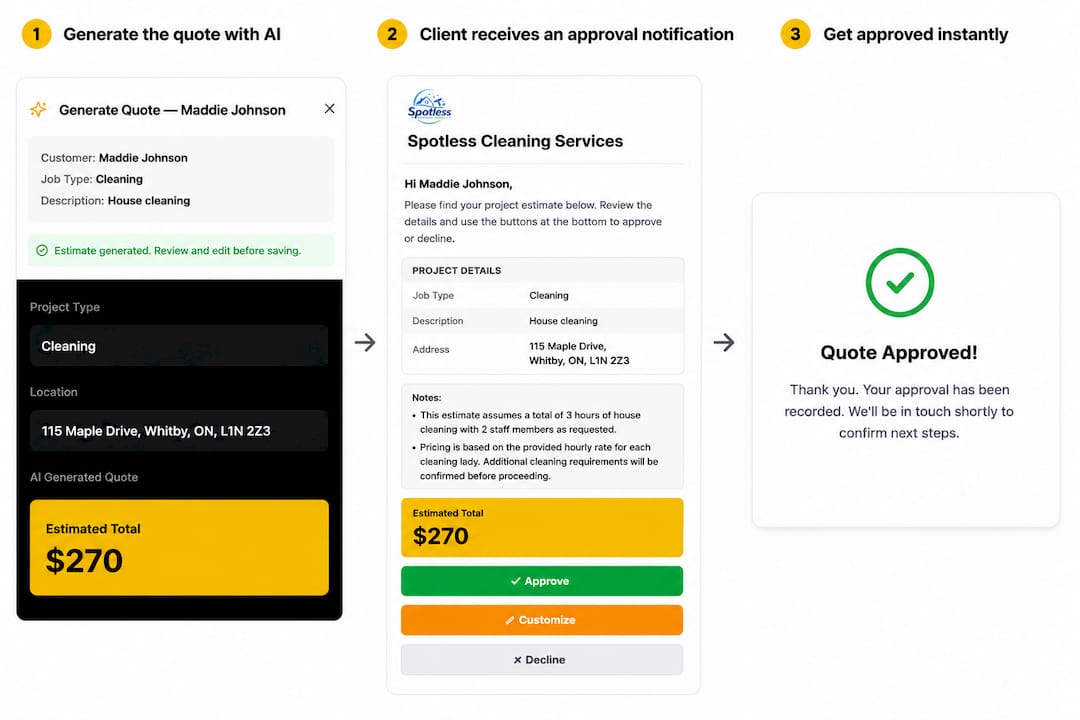
ServlyPro handles the parts of after-hours pricing that are easiest to mess up under pressure. AI-powered quotes apply your time-band rates automatically, so a tired technician isn’t doing multiplier math on a truck dashboard at midnight. Built-in quote approval captures the customer’s written “yes” before dispatch, with automatic follow-up if they don’t respond right away. Job scheduling keeps your time bands, response tiers, and technician assignments organized so the right rate applies to the right call, without anyone checking a chart by flashlight.
If you’re ready to see how it fits your trade, check out ServlyPro’s field service software for U.S. contractors and start a free trial today.